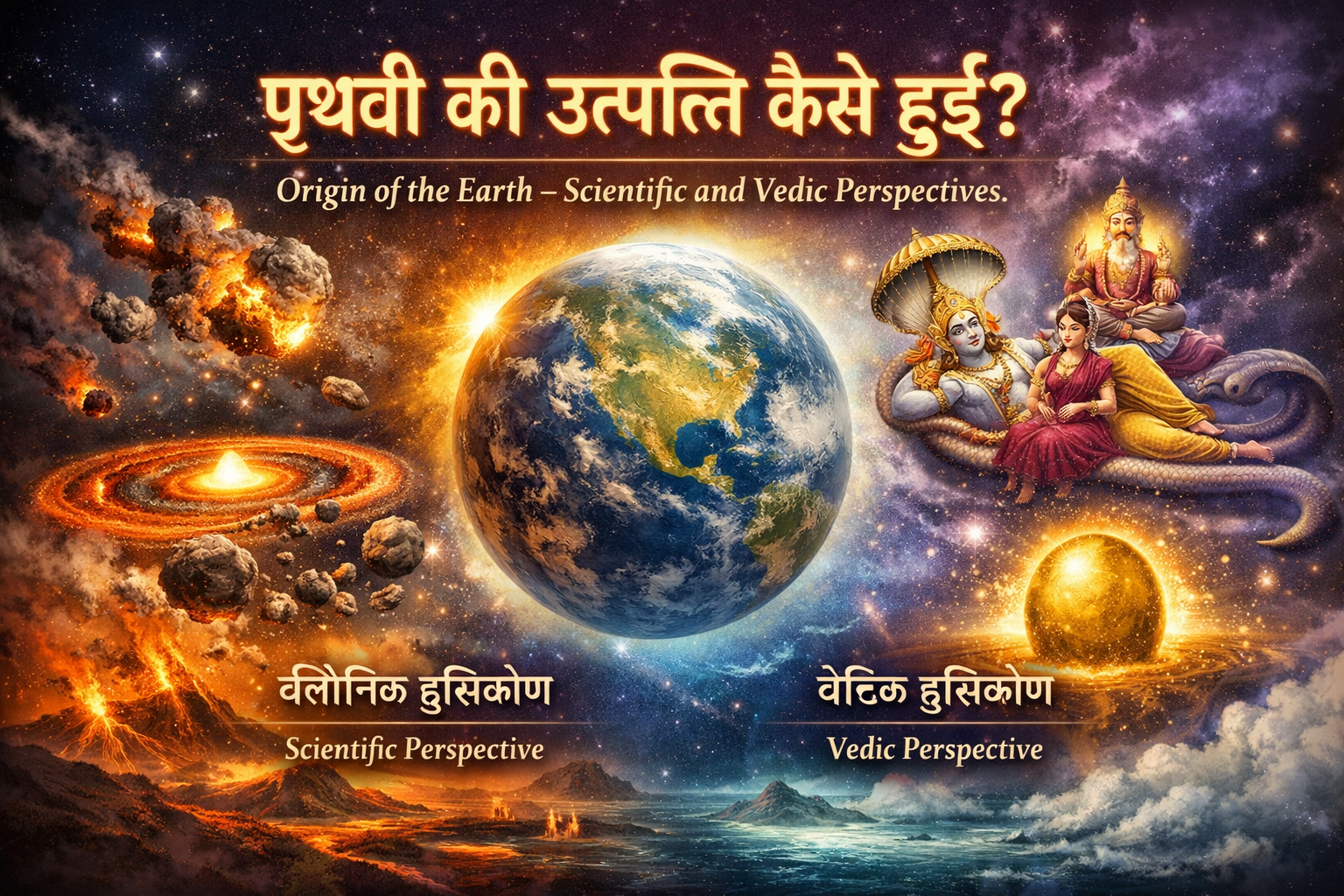
पृथ्वी की उत्पत्ति कैसे हुई? | (Origin of the Earth – Scientific and Vedic Perspectives)
in Sanatan KnowledgeAbout this course
हिन्दी:
यह पाठ्यक्रम पृथ्वी की उत्पत्ति के वैज्ञानिक एवं वैदिक दोनों दृष्टिकोणों का विस्तृत अध्ययन प्रस्तुत करता है। इसमें ब्रह्मांड की उत्पत्ति, सौरमंडल का निर्माण, पृथ्वी के निर्माण की प्रक्रिया तथा जीवन की उत्पत्ति का क्रमबद्ध वर्णन किया गया है।
English:
This course provides a comprehensive study of the origin of Earth from both scientific and Vedic perspectives. It covers the formation of the universe, the solar system, the Earth, and the emergence of life in a structured and detailed manner.
Comments (0)
📝 अध्याय 1: बिग बैंग सिद्धांत (Big Bang Theory)
हिन्दी:
बिग बैंग सिद्धांत ब्रह्मांड की उत्पत्ति को समझाने वाला एक प्रमुख वैज्ञानिक सिद्धांत है। इसके अनुसार लगभग 13.8 अरब वर्ष पूर्व समस्त ब्रह्मांड एक अत्यंत सूक्ष्म, अत्यधिक घनत्व एवं ऊष्मा से युक्त बिंदु (सिंगुलैरिटी) में संकेंद्रित था। अचानक हुए एक महाविस्फोट के परिणामस्वरूप यह बिंदु तेजी से फैलने लगा, जिससे समय, स्थान, ऊर्जा एवं पदार्थ का निर्माण हुआ।
समय के साथ यह विस्तार जारी रहा और आकाशगंगाओं, तारों तथा ग्रहों का निर्माण हुआ। यह सिद्धांत ब्रह्मांड के निरंतर विस्तार को भी स्पष्ट करता है और आधुनिक खगोल विज्ञान का आधार माना जाता है।
मुख्य बिंदु:
ब्रह्मांड की शुरुआत एक सिंगुलैरिटी से हुई
महाविस्फोट के बाद तीव्र विस्तार हुआ
समय, स्थान और पदार्थ का निर्माण
आकाशगंगाओं एवं तारों का विकास
ब्रह्मांड आज भी विस्तार कर रहा है
English:
The Big Bang Theory is a fundamental scientific explanation of the origin of the universe. According to this theory, approximately 13.8 billion years ago, the entire universe was concentrated in an अत्यंत small, dense, and extremely hot نقطة known as a singularity. A sudden expansion triggered the formation of space, time, energy, and matter.
Over time, the universe continued to expand, leading to the formation of galaxies, stars, and planetary systems. This theory also explains the ongoing expansion of the universe and serves as a foundation of modern cosmology.
Key Points:
Universe originated from a singularity
Rapid expansion occurred after the event
Formation of space, time, and matter
Development of galaxies and stars
Universe continues to expand
हिन्दी:
वैदिक सृष्टि सिद्धांत के अनुसार इस ब्रह्मांड की उत्पत्ति किसी आकस्मिक घटना का परिणाम नहीं है, बल्कि यह एक दिव्य एवं सुनियोजित प्रक्रिया है, जिसे परम चेतना (ब्रह्म) द्वारा संचालित किया जाता है। वेदों में सृष्टि के आरंभ को अत्यंत गूढ़ एवं दार्शनिक रूप में वर्णित किया गया है।
ऋग्वेद के नासदीय सूक्त में उल्लेख मिलता है कि सृष्टि के प्रारंभ में न तो अस्तित्व था और न ही अनस्तित्व, न आकाश था और न ही पृथ्वी। सब कुछ एक अदृश्य, निराकार एवं अनंत शक्ति में समाहित था। उसी परम शक्ति से सृष्टि का प्रकट होना प्रारंभ हुआ।
वैदिक दृष्टिकोण के अनुसार सृष्टि एक चक्रीय प्रक्रिया है, जिसमें सृजन (उत्पत्ति), पालन (स्थिति) और संहार (प्रलय) निरंतर चलते रहते हैं। इस चक्र को ब्रह्मा, विष्णु और महेश (शिव) के रूप में प्रतीकात्मक रूप से समझाया गया है।
यह सिद्धांत केवल भौतिक सृष्टि ही नहीं, बल्कि चेतना, आत्मा और ब्रह्म के संबंध को भी स्पष्ट करता है, जो इसे वैज्ञानिक सिद्धांतों से भिन्न बनाता है।
मुख्य बिंदु:
सृष्टि का मूल कारण ब्रह्म (परम चेतना) है
प्रारंभ में सब कुछ अव्यक्त (अदृश्य) था
सृष्टि का प्रकट होना दिव्य प्रक्रिया है
सृष्टि चक्रीय है: सृजन, पालन, संहार
ब्रह्मा, विष्णु, महेश सृष्टि चक्र के प्रतीक हैं
चेतना एवं आत्मा का महत्वपूर्ण स्थान
English:
The Vedic Theory of Creation explains the origin of the universe as a divine and well-ordered process governed by a supreme consciousness known as Brahman. Unlike purely scientific explanations, Vedic literature presents creation in a deeply philosophical and spiritual context.
The Nasadiya Sukta of the Rigveda describes the state before creation as one where neither existence nor non-existence was present. There was no sky, no earth—only an infinite, formless, and unmanifest reality. From this supreme consciousness, the universe gradually manifested.
According to the Vedic perspective, creation is cyclical in nature, consisting of three continuous phases: creation (Srishti), preservation (Sthiti), and destruction (Pralaya). These phases are symbolically represented by Brahma, Vishnu, and Shiva.
This theory not only explains the physical universe but also emphasizes the role of consciousness, the soul, and the ultimate reality, making it distinct from modern scientific theories.
Key Points:
Creation originates from Brahman (Supreme Consciousness)
Initial state was unmanifest and formless
Universe emerged through a divine process
Cyclical nature: creation, preservation, destruction
Symbolism of Brahma, Vishnu, and Shiva
Importance of consciousness and soul
हिन्दी:
सौरमंडल का निर्माण लगभग 4.6 अरब वर्ष पूर्व एक विशाल गैसीय एवं धूल के बादल, जिसे नीहारिका (Nebula) कहा जाता है, से हुआ। यह नीहारिका मुख्यतः हाइड्रोजन एवं हीलियम गैस से बनी थी। गुरुत्वाकर्षण बल के प्रभाव से यह बादल धीरे-धीरे संकुचित होने लगा और इसके केंद्र में अत्यधिक ताप एवं दाब उत्पन्न हुआ, जिससे सूर्य का निर्माण हुआ।
सूर्य के निर्माण के पश्चात शेष गैस एवं धूल उसके चारों ओर एक चक्राकार डिस्क (Protoplanetary Disk) के रूप में घूमने लगी। समय के साथ इस डिस्क के कण आपस में टकराकर बड़े पिंडों में परिवर्तित हुए, जिन्हें ग्रहाणु (Planetesimals) कहा जाता है। ये ग्रहाणु आगे चलकर ग्रहों, उपग्रहों एवं अन्य खगोलीय पिंडों में विकसित हुए।
इस प्रकार, सौरमंडल का निर्माण एक क्रमिक एवं प्राकृतिक प्रक्रिया के रूप में हुआ, जिसमें गुरुत्वाकर्षण, टकराव एवं संघटन (Accretion) की महत्वपूर्ण भूमिका रही।
मुख्य बिंदु:
सौरमंडल का निर्माण नीहारिका (Nebula) से हुआ
गुरुत्वाकर्षण के कारण बादल संकुचित हुआ
केंद्र में सूर्य का निर्माण हुआ
शेष पदार्थ से प्रोटोप्लानेटरी डिस्क बनी
कणों के टकराव से ग्रहों का निर्माण हुआ
यह एक क्रमिक (Gradual) प्रक्रिया थी
English:
The solar system was formed approximately 4.6 billion years ago from a विशाल cloud of gas and dust known as a nebula. This nebula primarily consisted of hydrogen and helium. Due to gravitational forces, the cloud began to collapse, leading to an increase in temperature and pressure at its center, eventually forming the Sun.
After the formation of the Sun, the remaining gas and dust formed a rotating disk called the protoplanetary disk. Over time, particles within this disk collided and combined to form larger bodies known as planetesimals. These planetesimals gradually evolved into planets, moons, and other celestial objects.
Thus, the solar system was formed through a gradual and natural process involving gravity, collision, and accretion.
Key Points:
Formed from a nebula (gas and dust cloud)
Gravitational collapse led to formation
Sun formed at the center
Remaining material formed a protoplanetary disk
Planetesimals formed through collisions
Gradual process of accretion
हिन्दी:
पृथ्वी का निर्माण लगभग 4.5 अरब वर्ष पूर्व सौरमंडल के निर्माण के दौरान हुआ। प्रारंभ में पृथ्वी अत्यधिक गर्म, द्रवित (molten) एवं अस्थिर अवस्था में थी, जहाँ लगातार उल्कापिंडों एवं अन्य खगोलीय पिंडों के टकराव हो रहे थे। इस प्रक्रिया को अभिवृद्धि (Accretion) कहा जाता है, जिसमें छोटे-छोटे कण आपस में जुड़कर बड़े पिंडों का निर्माण करते हैं।
समय के साथ पृथ्वी धीरे-धीरे ठंडी होने लगी। भारी तत्व जैसे लोहा एवं निकेल नीचे की ओर धंसकर केंद्र (Core) का निर्माण करने लगे, जबकि हल्के तत्व ऊपर की ओर आकर मेंटल (Mantle) और भूपर्पटी (Crust) का निर्माण करने लगे। इस प्रक्रिया को विभेदन (Differentiation) कहा जाता है।
पृथ्वी के ठंडा होने के बाद इसकी सतह पर जलवाष्प का संघनन हुआ, जिससे महासागरों का निर्माण हुआ। इसके साथ ही वायुमंडल का विकास हुआ, जिसने जीवन के लिए अनुकूल परिस्थितियाँ तैयार कीं।
मुख्य बिंदु:
पृथ्वी का निर्माण लगभग 4.5 अरब वर्ष पूर्व हुआ
प्रारंभिक अवस्था अत्यधिक गर्म एवं द्रवित थी
अभिवृद्धि (Accretion) के माध्यम से निर्माण
विभेदन (Differentiation) से परतों का निर्माण
कोर, मेंटल एवं क्रस्ट का विकास
जल एवं वायुमंडल का निर्माण
जीवन के लिए अनुकूल परिस्थितियाँ बनीं
English:
The Earth was formed approximately 4.5 billion years ago during the early stages of the solar system. Initially, it existed in a अत्यंत hot, molten, and unstable state, experiencing frequent collisions with meteorites and other celestial bodies. This process, known as accretion, involved the gradual accumulation of smaller particles into larger masses.
As the Earth began to cool over time, heavier elements such as iron and nickel sank toward the center, forming the core, while lighter materials rose to form the mantle and crust. This process is known as differentiation.
With further cooling, water vapor condensed to form oceans, and an atmosphere developed around the planet. These changes created suitable conditions for the emergence of life.
Key Points:
Formed about 4.5 billion years ago
Initially hot and molten state
Formation through accretion
Differentiation created internal layers
Development of core, mantle, and crust
Formation of oceans and atmosphere
Conditions became suitable for life
हिन्दी:
पृथ्वी पर जीवन की शुरुआत एक अत्यंत जटिल एवं क्रमिक प्रक्रिया के रूप में हुई। वैज्ञानिकों के अनुसार जीवन का आरंभ लगभग 3.5 से 4 अरब वर्ष पूर्व महासागरों में हुआ। प्रारंभिक पृथ्वी पर वातावरण अत्यधिक गर्म था और इसमें ऑक्सीजन की मात्रा बहुत कम थी। ऐसे वातावरण में सरल रासायनिक यौगिकों के परस्पर क्रिया करने से जीवन के प्रथम रूप का निर्माण हुआ।
सबसे प्रारंभिक जीव सूक्ष्म जीवाणु (Microorganisms) थे, जिन्हें प्रोकैरियोटिक कोशिकाएँ (Prokaryotic Cells) कहा जाता है। समय के साथ ये सरल जीव विकसित होकर जटिल जीवों में परिवर्तित हुए। इस विकास प्रक्रिया को विकासवाद (Evolution) कहा जाता है, जिसे चार्ल्स डार्विन के सिद्धांत द्वारा समझाया गया है।
पृथ्वी पर जल, उचित तापमान, तथा वायुमंडल की उपस्थिति ने जीवन के विकास में महत्वपूर्ण भूमिका निभाई। धीरे-धीरे वनस्पतियों, जीव-जंतुओं और अंततः मानव का विकास हुआ।
मुख्य बिंदु:
जीवन की शुरुआत लगभग 3.5–4 अरब वर्ष पूर्व हुई
प्रारंभिक जीवन महासागरों में उत्पन्न हुआ
सूक्ष्म जीवाणु प्रथम जीव थे
प्रोकैरियोटिक कोशिकाओं से शुरुआत
विकासवाद (Evolution) के माध्यम से जटिल जीवन विकसित हुआ
जल, तापमान और वातावरण महत्वपूर्ण कारक थे
अंततः मानव का विकास हुआ
English:
The origin of life on Earth was a complex and gradual process. According to scientific evidence, life began approximately 3.5 to 4 billion years ago in the oceans. The early Earth had a hot environment with very little oxygen, where simple chemical compounds interacted to form the earliest forms of life.
The first living organisms were microorganisms known as prokaryotic cells. Over time, these simple organisms evolved into more complex forms through a process known as evolution, as explained by Charles Darwin.
The presence of water, suitable temperature, and a stable atmosphere played a crucial role in the development of life. Gradually, plants, animals, and eventually humans evolved on Earth.
Key Points:
Life began around 3.5–4 billion years ago
Originated in oceans
First life forms were microorganisms
Started with prokaryotic cells
Evolution led to complex organisms
Water, temperature, and atmosphere were essential
Eventually led to human evolution
हिन्दी:
सनातन धर्म में पृथ्वी को ‘पृथ्वी माता’ के रूप में अत्यंत आदर एवं श्रद्धा के साथ पूजनीय माना गया है। इसे समस्त जीवों के पालन-पोषण का आधार एवं जीवनदायिनी शक्ति के रूप में देखा जाता है। वेदों, पुराणों तथा अन्य धार्मिक ग्रंथों में पृथ्वी को धैर्य, सहनशीलता, स्थिरता एवं करुणा का प्रतीक बताया गया है।
सनातन परंपरा के अनुसार पृथ्वी केवल एक भौतिक ग्रह नहीं, बल्कि एक चेतन सत्ता का रूप है, जो समस्त प्राणियों को धारण करती है। मनुष्य का कर्तव्य है कि वह पृथ्वी एवं प्रकृति का संरक्षण करे, क्योंकि यह संतुलन ही जीवन के अस्तित्व का आधार है।
धार्मिक मान्यताओं में पृथ्वी से जुड़ी अनेक परंपराएँ एवं आचार-विचार सम्मिलित हैं, जैसे प्रातःकाल भूमि को स्पर्श कर क्षमा याचना करना, वृक्षों एवं नदियों की पूजा करना, तथा प्राकृतिक संसाधनों का संयमित उपयोग करना। ये सभी आचरण मानव को प्रकृति के प्रति जिम्मेदार बनाते हैं।
मुख्य बिंदु:
पृथ्वी को ‘पृथ्वी माता’ के रूप में पूजनीय माना गया है
जीवन के पालन-पोषण का आधार
धैर्य, सहनशीलता एवं स्थिरता का प्रतीक
प्रकृति संरक्षण का महत्व
धार्मिक परंपराएँ एवं आचार-विचार
संतुलित एवं जिम्मेदार जीवन की प्रेरणा
English:
In Sanatan Dharma, Earth is revered as “Prithvi Mata” (Mother Earth) and is considered sacred. It is regarded as the foundation of all life and the nurturing force that sustains all living beings. Vedic and Puranic texts describe Earth as a symbol of patience, stability, tolerance, and compassion.
According to this tradition, Earth is not merely a physical planet but a conscious entity that supports all forms of life. Humans have a moral responsibility to protect and preserve nature, as ecological balance is essential for survival.
Various cultural practices and traditions reflect this reverence, such as offering respect to the Earth in the morning, worshipping trees and rivers, and using natural resources responsibly. These practices encourage a sustainable and harmonious way of living.
Key Points:
Earth is worshipped as “Mother Earth”
Foundation of all life
Symbol of patience, stability, and compassion
Emphasis on environmental protection
Cultural and spiritual practices مرتبط with Earth
Encourages responsible and balanced living